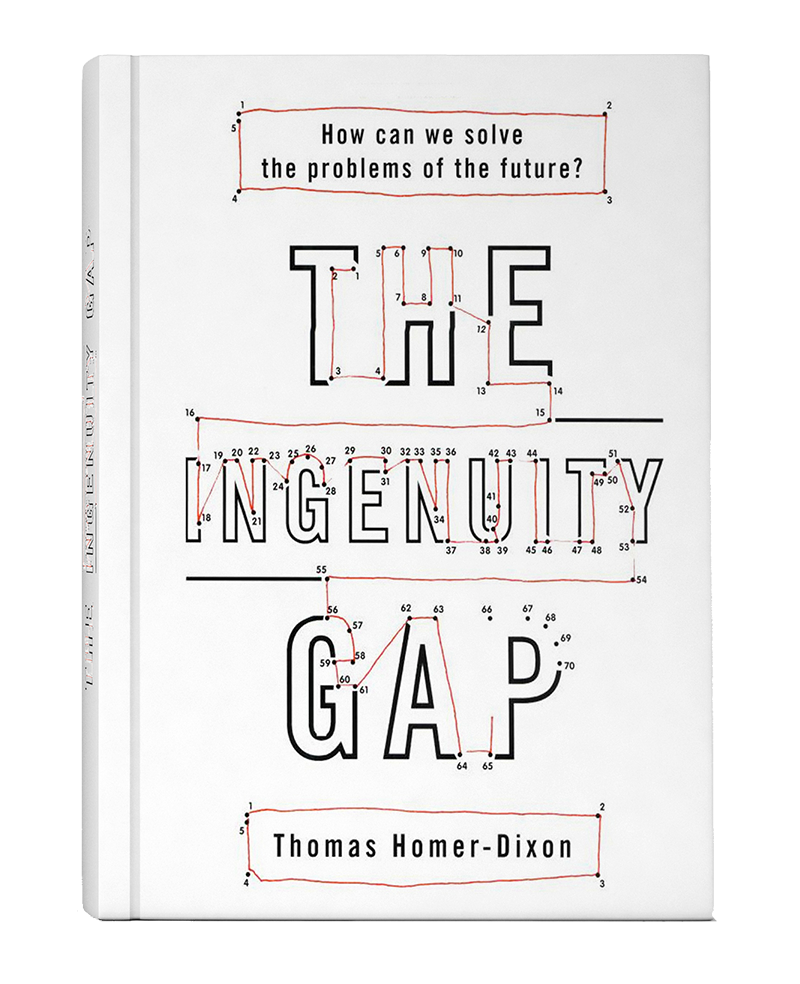
Welcome to the "Ingenuity Theory" page
of this website. A brief note of introduction: In The Ingenuity
Gap, I don't provide much detail on the theory that underpins my thinking
about ingenuity and its role in modern societies. There are a number of difficult
technical issues that I mention only in passing in the book. In the following
pages, I have begun to address some of these issues, and I would be delighted to
receive feedback on my ideas in the Forum section of this website. Below,
I discuss or will soon discuss: The advantages and disadvantages
of the "sets of instructions" definition of ingenuity that I adopt.
How we might usefully measure ingenuity. How we might
usefully think about the "quality" of ingenuity. How our social,
economic, and political values affect the requirement for ingenuity and its
supply. A more refined categorization of ingenuity types than the
simple technical/social distinction used in the book. The
complete set of factors (as I see it) driving up our requirement for ingenuity in
today's world and the specific causal relations among these factors.
The benchmark against which we should measure our rising requirement for
ingenuity. (In my previous writings, I've used a standard that I call the
"constant-satisfaction requirement," which is the amount of ingenuity required to
maintain a society's aggregate utility. See my original "Ingenuity Gap" article,
cited below.) How our time horizon (or what economists would call
our "discount rate") affects our current requirement for ingenuity.
A systematic account of the factors that constrain the supply of
ingenuity. The recursive nature of ingenuity supply (i.e., that
we need ingenuity to generate and deliver ingenuity). The
distribution and use of ingenuity within an economy and society (a matter that is
quite distinct from the strict issue of supply). And finally, why
the "political will" rebuttal to my argument (i.e., that the real problem in our
world is not an ingenuity gap but a lack of political will) is bogus.
I have a good deal of material on all these issues already available,
but much of it is in note form. As I convert these notes into fully elaborated
arguments, I am delivering them to this page. Readers interested in an early
attempt to deal with some of the above theoretical issues should read my original
"Ingenuity Gap" article, which appeared in the journal Population and
Development Review in 1995; this article can be found at
www.homerdixon.com/projects/ingen/ingen.htm. INGENUITY THEORY The Value Added
of the Ingenuity Gap Concept The first question I must address is:
What is the "value added" of this approach? Some might argue that when I say
we're facing an ingenuity gap, I'm saying nothing more than we have a problem
that can't be solved. But in our common usage, problems and their
solutions are, as philosophers would say, "internally related"--that is, they are
defined in terms of their relationships to each other. The difficulty of a given
problem can't be assessed independently of our judgement about the solutions
available to address it, and the quality of a given solution can't be assessed
without reference to the problem it is intended to address. This means that
problems and their solutions tend to be conflated with each other; it's difficult
to examine one without sliding into an examination of the other. The
ingenuity gap approach, however, allows us, at least in principal, to separate
problems from solutions and examine them independently. A given problem can be
understood as a particular requirement for ingenuity, and if we can work out a
way of measuring ingenuity (something I discuss below), then we can assess the
nature or difficulty of the problem without reference to its putative solutions.
Similarly, a given solution becomes a particular amount and type of ingenuity
supplied, something that it is again possible to assess, at least in principal,
without reference to the problem the ingenuity is intended to solve. Problems and
solutions are reduced to a common, but independent and objective yardstick of
comparison ingenuity. Moreover, once problems and solutions
are separated from each other, we can more effectively examine the many factors
that can make our problems harder, as well as the many factors that can constrain
our ability to solve those problems. I have found this separation of the two
sides of the gap--ingenuity requirement and supply--to be a particularly helpful
intellectual discipline. For example, there are various kinds of
constraints on scientific progress. Some affect the supply of scientific
ingenuity and others affect the requirement for this ingenuity. Human cognitive
limits, which restrict our ability to grasp the workings of complex systems in
their entirety, are a supply-side constraint. On the other hand, the intrinsic
difficulty of scientific problems, something that is a function of the
fundamental characteristics of our natural world, is independent of our cognitive
ability, and is a key factor determining our overall requirement for scientific
ingenuity. Sometimes this requirement can exceed our cognitive ability, producing
an ingenuity gap. But when we clearly distinguish between requirement and supply
effects, we can say more than this: we can say whether the ingenuity gap is
getting wider or narrower because features of our external world are changing
(that is, because our scientific problems are getting intrinsically harder or
easier) or because our cognitive ability is changing. (Normally admittedly, it's
the former, but we shouldn't exclude the possibility of the latter--see my
discussion in chapter 13 of the effects of toxins on brain development and
performance.) So, distinguishing between ingenuity requirement and supply
is a more powerful analytical move than it might seem at first. It allows us to
distinguish between changes in our world in a way that we couldn't otherwise.
When we say that we face an ingenuity gap, we highlight a key question: Are the
forces making this problem hard to solve affecting ingenuity requirement or
supply?
Measuring Ingenuity Quantity: The Utility of the "Sets of
Instructions" Approach This brings us to the second key question: How
do we measure ingenuity? Implicit in any discussion of requirement and supply is
the assumption that it is possible, at least in principal, to measure ingenuity.
In The Ingenuity Gap I define ingenuity as "sets of instructions that tell
us how to arrange the constituent parts of our physical and social worlds in ways
that help us achieve our goals." I go on to suggest that one measure of ingenuity
might be the length of this set of instructions. (I'm assuming that a "set of
instructions" consists of an ordered list of statements, in which each statement
describes an action that one must execute--in the specific sequence prescribed by
the list--if one is to achieve one's goal. Therefore, each additional action
specified in the list lengthens that set of instructions.) By this account, a
longer set of instructions represents more ingenuity. This raises some
tricky issues, however. For one thing, some of the instructions might simply be
repetitions of ones that appeared earlier in the set; so you could have a long
set of instructions in which many of the instructions don't provide much novelty
or extra content. I think this is a manageable difficulty however, because we can
stipulate that the amount of ingenuity in a proposed solution to a given problem
is represented by the most compact set of instructions that describes that
solution. We can make a set of instructions that contains a lot of repetitions of
actions more compact, perhaps, by using "repeat" or "do loop" commands, similar
to those used in computer programming languages. Readers familiar with my
book will see a resonance between this approach to measuring ingenuity and some
suggested methods (reviewed at the end of chapter 4, especially in the endnotes)
for measuring a system's complexity. A system's "algorithmic complexity" is
represented by the length of a computer algorithm that adequately reproduces that
system's behavior. Software engineers are also developing methods for gauging the
complexity of computer programs, as a means of standardizing software development
and better identifying bugs. These methods suggest that, at least in principal,
the general task of developing a measure of ingenuity quantity is tractable.
Measuring Ingenuity Quality The bigger challenge,
though, is to measure the quality of ingenuity. Using the "length of the
set of instructions" as a yardstick really only allows us to measure the
quantity of ingenuity. There is a trap here, though: we must be careful to
ensure that our measure of the quality of the ingenuity represented by a
particular set of instructions is independent of our assessment of the
effectiveness of the solution that the set of instructions represents. In other
words, we can't say that better ingenuity solves our problems better. Otherwise,
we end up conflating ingenuity requirement and supply, because as the problems
and challenges we face get harder, our existing solutions are less effective,
which suggests (if we measure the quality of ingenuity by its effectiveness in
providing solutions) that the amount of ingenuity we have available to us
declines. This conflation of requirement and supply negates the main advantage of
the whole approach, which is to allow the independent analysis of requirement and
supply. I identify and discuss this difficulty in chapter 9 of the book (in
"Ingenuity and Wealth," pp. 230-1). We shouldn't underestimate the
difficulty of measuring the quality of ingenuity, especially if we need a measure
that's independent of the ingenuity's effectiveness as a solution. I've puzzled
over this problem for years, and I've concluded that we can learn much from
discussions in philosophy of science about standards for "theory choice"--that
is, the about the criteria scientists use to decide whether one scientific theory
is better than another as an explanation or as a predictor of a given phenomenon
in our world. It seems reasonable to assume that the criteria we use to determine
whether one scientific theory is "better" than another can also help us determine
whether one practical idea for addressing a given problem is "better" than
another. Three criteria of theory choice, widely cited by philosophers of
science, are:
parsimony; congruity with already established
scientific theories (a better theory is one that fits better with already
established understandings of the world); and, explanatory scope
(a better theory is one that makes better "sense" of a wider range of empirical
data than other theories, especially data that appear to contradict those other
theories what philosophers of science call "anomalous
data"). Parsimony and explanatory scope often pull in opposite
directions: increasing the latter often requires more complex theories that
sacrifice some of the former. One way of getting around this problem is to
combine the two criteria into an "efficiency" or "bang-for-the-buck" measure--by
such a measure, the better theory provides greater explanatory return for a given
amount of cognitive effort invested in understanding and using the theory.
So, in general, better scientific theories are simpler ones that explain more
and that are more congruent with our existing understanding of the world. How do
we apply these criteria to measuring the quality of ingenuity? It seems fairly
easy to transfer parsimony and congruity to this new role. Thus it would seem
that, all other things being equal, a set of instructions would represent higher
quality ingenuity than another if it's simpler or shorter and if it's more
congruent with existing ways of solving our problems. Note that we have a tension
here between our measures of quantity and quality of ingenuity: a longer set of
instructions might represent a greater quantity but a lower quality of ingenuity.
That seems entirely reasonable: in various spheres of our lives, we often note
that there is a trade-off between quantity and quality. Note, too, that by these
criteria, "out-of-the-box" or lateral thinking (which, by definition, is
incongruous with conventional thinking) is not valuable in and of itself.
The third criterion--explanatory scope--is more difficult to use as a gauge of
ingenuity quality, since the point of ingenuity, unlike scientific theories, is
not explanation of anything. Rather, the point of ingenuity is to provide us with
solutions to our problems. But I've already established that we can't use
"effectiveness as a solution" as a criterion. There is, however, another
implication of the"explanatory scope" criterion. If we adopt a realist ontology
(that is, if we assume that there exists a "real" world independent of the human
mind), and if we also adopt a "correspondence theory of truth" epistemology (that
is, if we assume that our scientific theories are more "true" to the extent that
they better correspond to or "map" onto that real world), then a scientific
theory with greater explanatory scope is generally one that provides a more
accurate representation of the world. By analogy, higher quality ingenuity would
consist of sets of instructions that correspond better to the "real" or "true"
characteristics of the world in which these instructions are to be implemented.
There are difficult issues here, of course: first, we might rebel against the
tight straightjacket imposed by these realist ontological and epistemological
positions; second, what we mean by "correspond" is not entirely obvious (my
general sense is that any high-quality set of instructions must have a close
relationship to the world in which it's to be implemented, but the nature of that
relationship has to be further specified); and, third, whether one set of
instructions corresponds better or worse to reality is often a subject of great
dispute. Regarding the first issue, I've always been suspicious of realist
ontologies and epistemologies, so I've accepted their relevance and value in this
context with some reluctance. But I've come to conclude that we need to adopt a
realist perspective if we are to avoid "internal" or "effectiveness" measures of
ingenuity quality--"internal" in the sense that quality of a given set of
instructions is gauged by its relationship to the problem it's intended to
address. If we adopt a realist perspective, we can potentially gauge ingenuity
quality by external or exogenous criteria--that is, by criteria independent of
the relationship between the ingenuity and the given problem. As for the
second issue, what would a "correspondence" relationship between ingenuity and
the real world consist of? How can we tell that one set of instructions
"corresponds" better to the real world than another? To address this question, I
find it helpful to return to my thought experiment (at the beginning of chapter
8) in which I'm trying to escape from my office. Let's say one set of
instructions for getting the flag up the chimney is identical to another, except
for one small difference: set "A" says we should screw the pieces of the pole
together inside the fireplace, while set "B" says we should screw them together
outside the fireplace. (In other words, the two sets of instructions are
identical except for the order of the instructions.) Of course, set A allows us
to incrementally extend the pole up the chimney, whereas set B will present
problems because the pole will be too long, when it's all connected together, to
put inside the fireplace and up the chimney. That set A is better than B
is a function of basic laws of physics and mechanics (relating to such things as
the ductility of the metal in the pole, the solidity of the materials in the
fireplace and chimney, and the mechanics of trying to get a pole of a certain
length through a space of certain dimensions). Notice that we're saying that set
A is better in this respect than B without any reference to whether A actually
solves better than B our overall problem of being trapped in the office. Rather,
set A simply "fits" the real world better than set B. This captures what I mean
by a "correspondence" relationship between ingenuity and the real world.
Regarding the third issue, I'm not sure that it's a real problem. Yes, we are
surrounded by disputes over whether one solution or another corresponds better to
reality. When two people vehemently disagree about the value (the quality) of
their respective solutions to a problem, the source of that disagreement is often
their differing judgement about the nature of the world (the "real
characteristics" of that world, if you will) in which their solutions are to be
implemented. But the existence of such dispute does not weaken the argument I'm
presenting here, because these are often entirely legitimate disputes over
entirely reasonable questions. In sum, as a first approximation, I believe
we can think about ingenuity quality as a joint function of the parsimony,
congruity, and "fit" (or "correspondence" with the real world) of the set of
instructions in question. Note something important: by this strategy for thinking
about ingenuity, we might sometimes supply large quantities of high-quality
ingenuity to address the problems around us without solving those problems. In
fact, sometimes the most effective solution might involve less and lower-quality
ingenuity than another.
Home |
Book Contents |
Book Excerpt |
Suggested Readings |
Ingenuity Theory |
About Thomas Homer-Dixon |
Order The Book
Copyright 2000 Random House, Inc. | Alfred A. Knopf |